



I’ve spent thousands of dollars on AI agents this year. They book things, buy things, and handle errands I used to lose whole evenings to. As a user, I’m sold.
That should make me bullish on agentic commerce. But it doesn’t. Because when you actually run the numbers on how these agents are supposed to make money, it all comes back to two things that don’t add up yet: take rates (the cut of each purchase) and unit economics (whether each sale makes or loses money).
Hate to be that guy. But personal agent startups are being valued like the next Expedia (Instinct went from a roughly $50M seed valuation to $10B in about five months this year, and is reportedly raising at $30B now), and I haven’t seen anyone show the math on a single transaction.
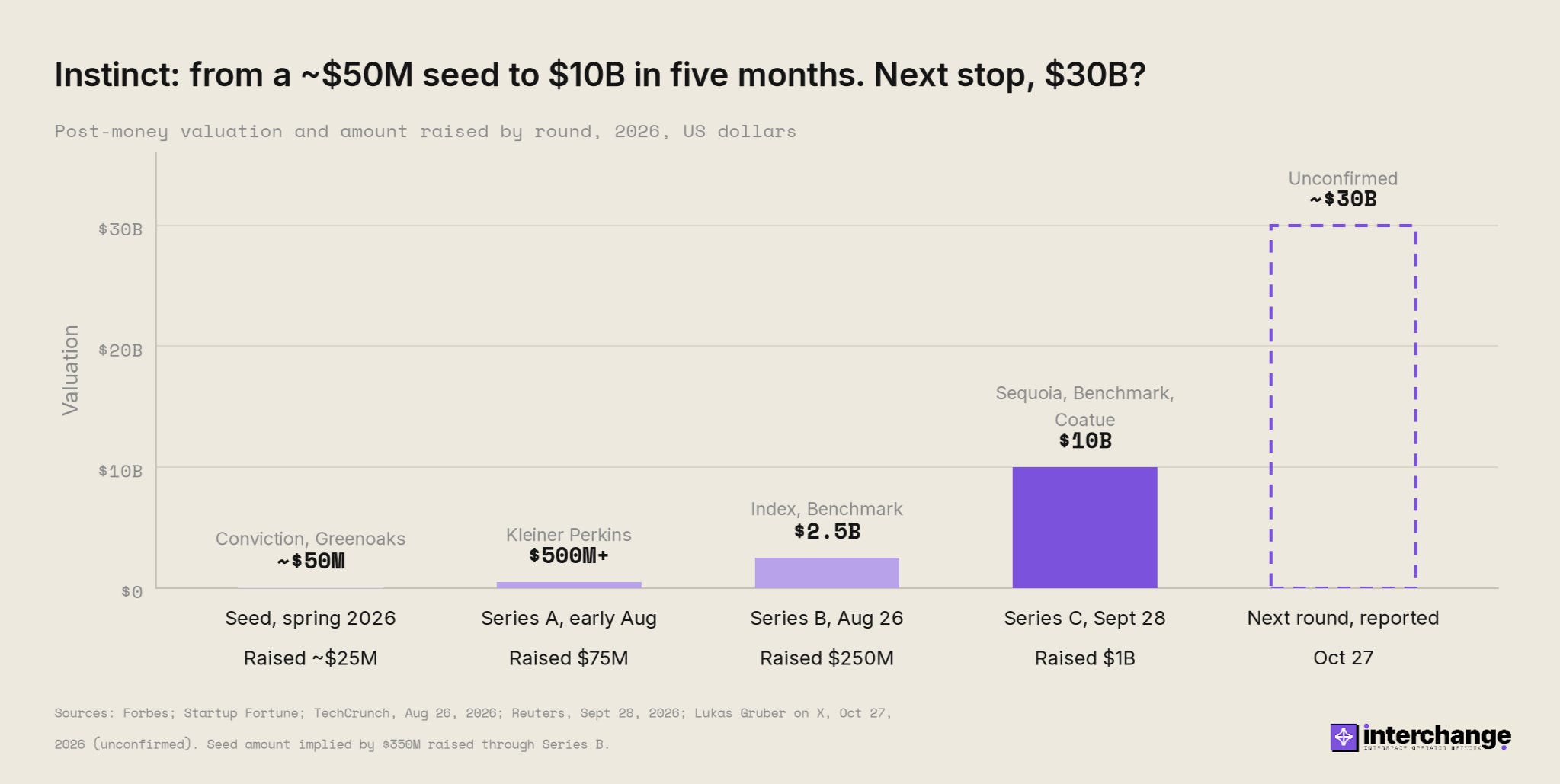
So let’s test it, Mythbusters-style: run one common transaction through the math, and if it fails, see what it would take to make it work. The enablement potential here is enormous. But the business model most of these companies are counting on, taking a cut of what you buy, doesn’t work at today’s cost of AI inference, even in the best case.
To be clear, this isn’t a takedown. Some of the smartest investors in the business are backing these companies, and I use these agents every day. The bull case is real: inference keeps getting cheaper, and whoever owns the customer can make money off them a dozen ways. I want to separate the facts from the hype so we as an industry get smarter about where the money is. The worst outcome would be for this to crash and burn and for people to write off agentic commerce entirely.
Why flights
I’m using flights because they’re the best case for agents.
Flights are genuinely hard to book well. Multiple travelers, international legs, seats together, a bassinet row for a baby, a layover you can actually make. It’s high-urgency, tedious, and full of tradeoffs which is exactly the kind of work you’d hand to an agent.
And people are doing so. Instinct’s founder says about half of its transactions are travel. If agent commerce works anywhere, it should work here.
Why not hotels? They look better on paper. Hotels pay far more, typically 15 to 25% of the booking to an online travel agency. But an agent doesn’t get that. It gets the affiliate slice, about 4% of the booking. The average US stay runs about $260 (roughly $160 a night for 1.6 nights), so that’s about $10 a booking. That sounds like room to spare, but hotels are harder than they look. Filter a flight by dates, times and nonstop, and you’re down to one to three options. Add your airline loyalty and it’s usually one. A hotel stay has hundreds: which chain you’re loyal to, which neighborhood, which amenities, a hotel or an Airbnb or a Vrbo, a room or a whole studio. Every one of those choices is more searching and more tokens. The high commission is a clue too. Hotels pay that much because getting someone to book is hard. Hotels aren’t the saving grace. They’re a harder version of the same problem.
Step one: Calculate revenue per booking
Start with what an agent earns when it sells you a flight.
In March 2002, Delta stopped paying travel agents base commissions on US tickets. Within about ten days, most other major US airlines did the same. Before that, agents earned around 5%, capped at $10 to $20 a ticket. Since then, the base commission on a US ticket has been zero.
What’s left comes from two places. The first is affiliate programs. Expedia pays its affiliates 0.3–0.5% on flights. On the high end, Aviasales, a regional flight search engine for Russia, keeps about 2.2% of the fare and passes partners 1.1–1.3%. The second is GDS booking incentives: the reservation systems airlines pay to list their fares kick back about $2 per flight segment (one takeoff and one landing) to large agencies, minus a fee of about 80 cents. A round trip is at least two segments, so that’s about $2.50, or roughly 0.6% of the fare. The biggest agencies do better today, but the best deals go to agencies booking at least 200,000 GDS segments a year, and a new agent is nowhere close.
These don’t stack: sell through an online travel agency’s affiliate program and the agency keeps the GDS incentive and passes you a slice.
The average US domestic fare in Q2 2026 was $445, per the Bureau of Transportation Statistics. That’s the price for one traveler, with a round trip counted as one fare. It excludes bag and seat fees so I am as well. A family of four earns four commissions for roughly the same work, but that’s not what the average booking looks like. Average the three routes (0.39% at Expedia, 1.2% at Aviasales, about 0.6% through a GDS) and you get about 0.7%. On the average fare, one booking earns $3.12. A smart agent would chase the best route, but so would every other agent, and that rate gets competed away like any spread a market maker finds. A US-weighted average sits closer to Expedia’s 0.39%.
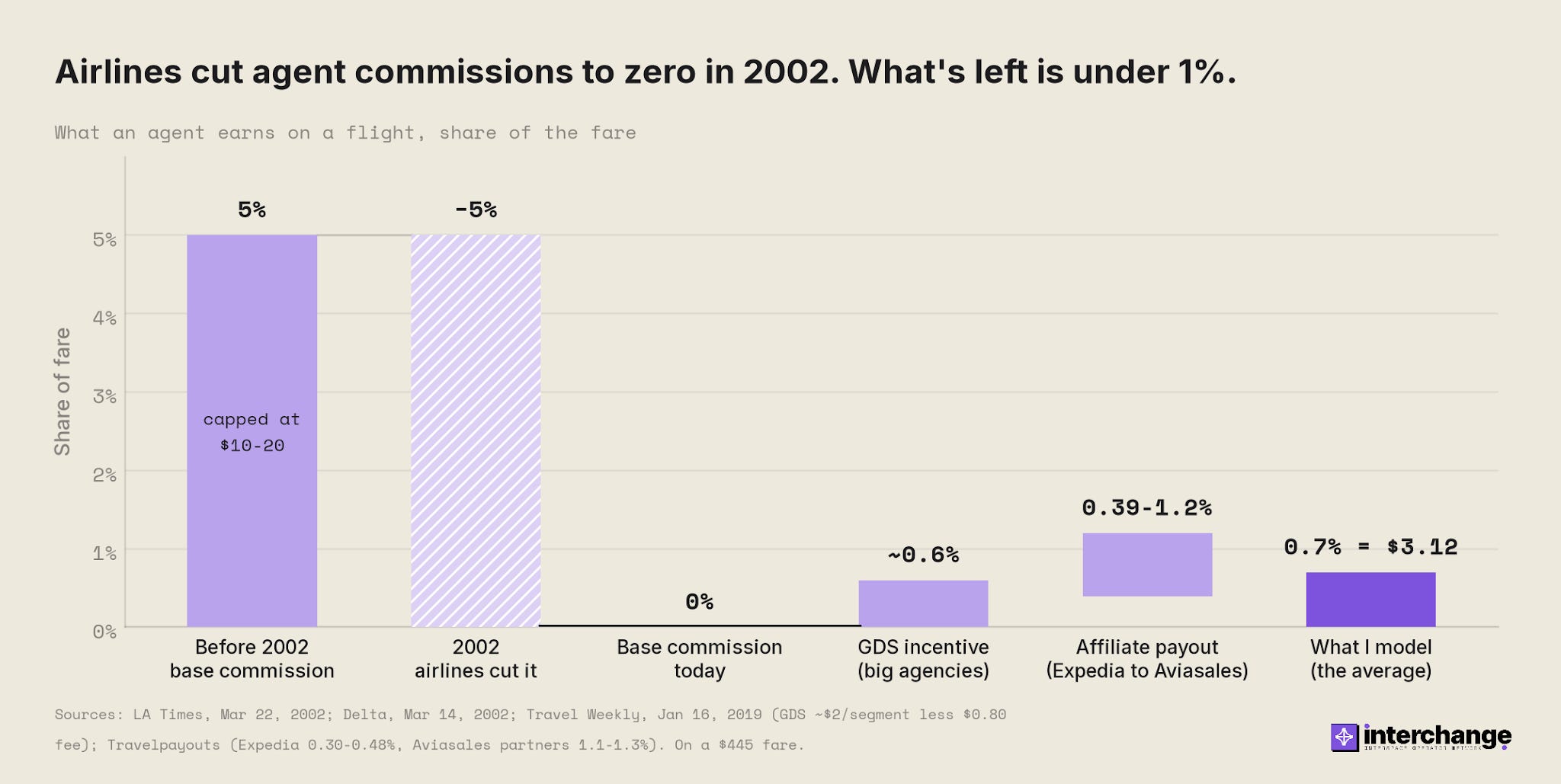
That’s not much. And it’s the model the most valuable agent startup is betting on: Instinct is free to users and plans to earn a take rate paid by merchants. It reportedly approaches $1B in annual transactions across 100,000+ users. That’s about $830 per user per month, which sounds like a lot of commerce. At 0.7%, that’s about $5.80 a month in revenue per user. Less than a streaming subscription.
Why even 0.7% is generous
The base commission is already zero. The GDS money goes to big agencies with volume contracts, and a new agent starts with neither.
Dozens of agent startups are chasing this exact same booking, and so are Google, OpenAI, Meta, and every online travel agency. They’re all selling the identical product: the same seat, on the same flight, at the same price. When that many players sell the same thing, the commission gets competed away. Through rebates and credits to win users, through marketing, through lower fees.
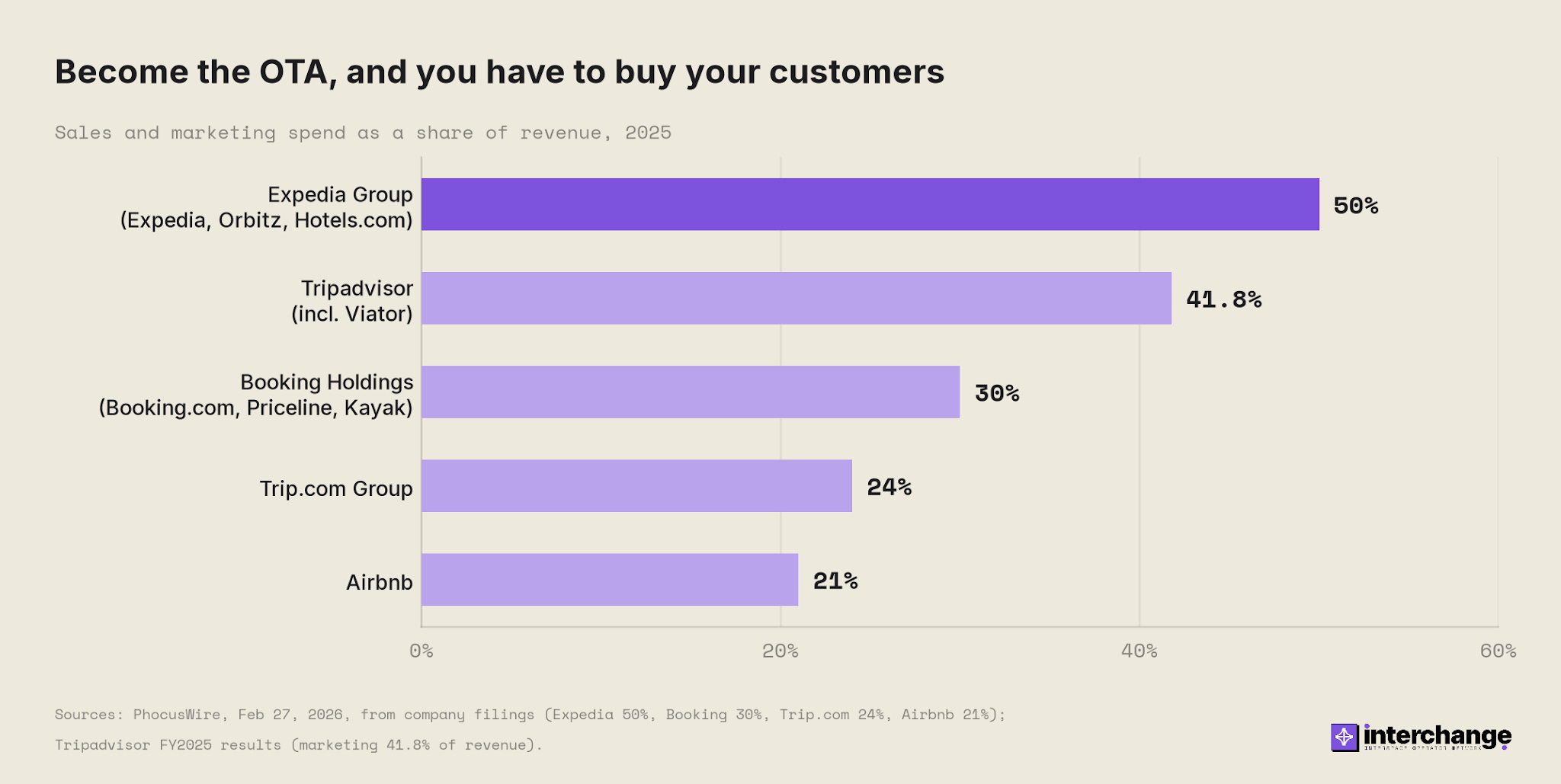
We already know what that looks like. Expedia, the largest online travel agency, spent $7.35B on direct sales and marketing in 2025 against $14.7B of revenue. Half of every revenue dollar went to winning the customer. And it isn’t just Expedia. Booking Holdings spent 30% of revenue on marketing, Trip.com 24% and Airbnb 21%. So “just become the OTA” doesn’t solve it. The OTAs pay heavily to stay on top.
And it gets more crowded over time. Airlines will deploy their own agents, and you won’t be able to browse their sites with computer use forever. You’ll integrate with them, they’ll set the terms, and some of them will charge you for access. That market already exists: flight APIs like Duffel let any developer sell airline tickets for $3 an order plus 1% of the fare. On an average ticket that’s $7.45 in fees, more than double what the agent earns, and the airline still pays no commission. Your agent will be negotiating with their agent, and every middleman takes a piece of the same $3.12.
So I use the average, 0.7%, or $3.12 per booking, and treat it as a ceiling, not a floor. And you can’t fix it with a booking fee. Online travel agencies charged $7 to $11 per ticket until 2009, when Expedia dropped the fee to stay competitive and Orbitz and Travelocity followed within days. Booking with the airline is free, so a fee just sends customers there.
Step two: Estimate what the cost to shop is
Now the cost side. An agent doesn’t answer a flight request in one shot. It works through a sequence of steps, and each step is a model call:
understand the request and ask a clarifying question
run several searches, including alternate dates and airports
filter and compare options
check fare rules and bag fees
pick a flight, enter passenger details
deal with the seat map, add-ons, and payment
confirm, and recover from the inevitable errors and retries
That’s 20 to 30 model calls for one session.
And I’m modeling how these agents actually work today. Most sites don’t give agents an API, so the agent gets its own computer: a cloud machine running a real browser, which it drives one step at a time, reading each page as a screenshot or as page text. It’s the most expensive way to read the web, and it’s the norm.
The part most people miss: on every call, the model re-reads everything that came before it. The system instructions, the tool definitions, every search result, every message. So the context grows with each step, and the total tokens (the units AI is billed in, roughly three-quarters of a word each) grow much faster than the number of steps.
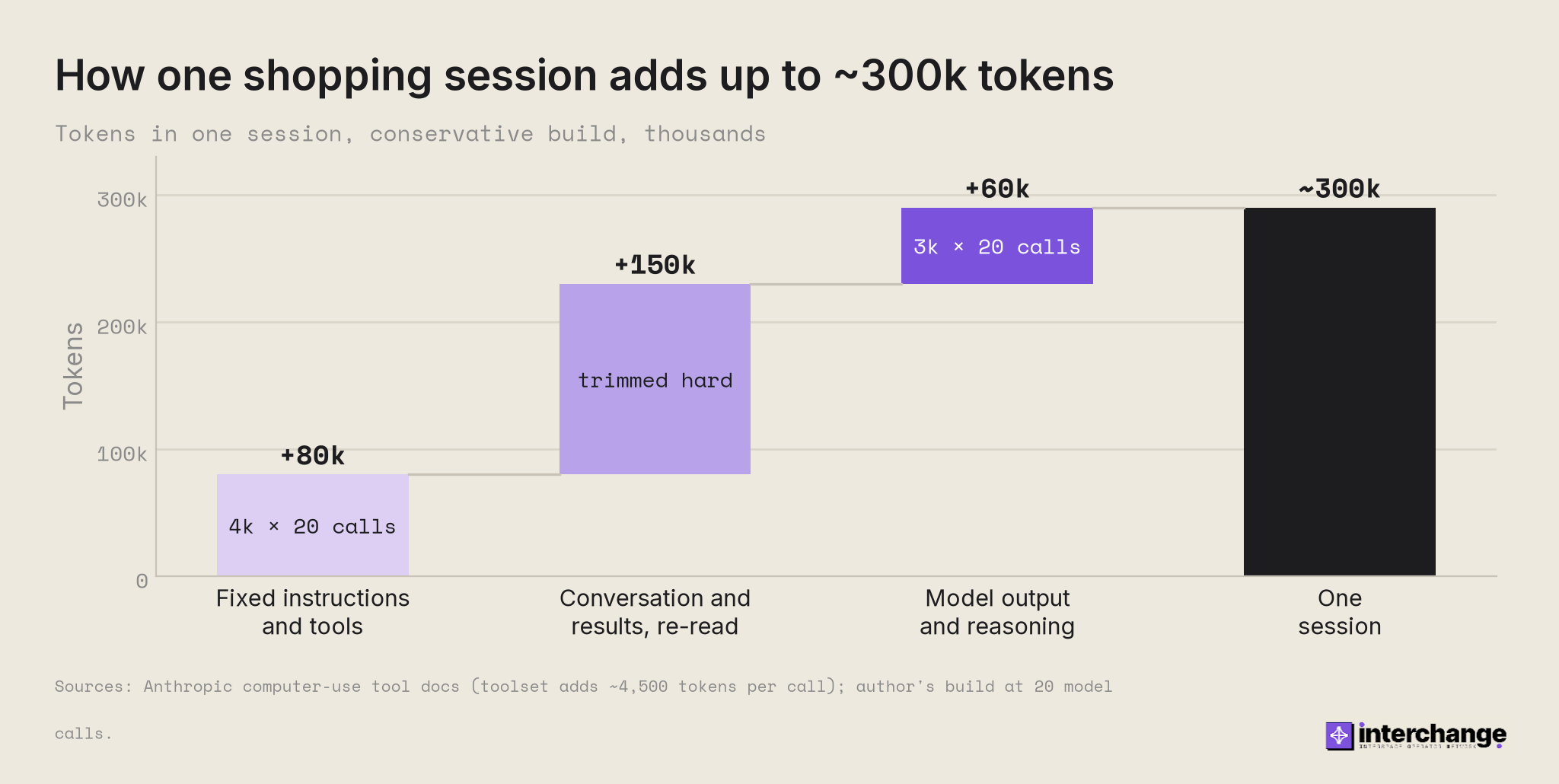
A conservative build for one shopping session:
Fixed instructions and tool definitions: ~4k tokens × 20 calls = 80k (Anthropic’s computer-use tools alone add about 4,500 tokens to every call, so this is light)
Conversation and results that accumulate step by step, trimmed hard: ~150k
The model’s own output and reasoning: ~3k × 20 calls = 60k
That’s about 290k. I’ll call it 300k tokens per session. At 30 calls, the same math lands well above 400k, so this isn’t the high end.
What a token costs and why caching doesn’t help much
To calculate the cost of a token, I took every model scoring 45 or higher on Artificial Analysis’s Intelligence Index that publishes a price, 13 in all, and used the median: $2 per million input tokens and $10 per million output tokens. That’s exactly the list price of Claude Sonnet 5.5, GPT-6.1 Sol and Gemini 4 Argon, the workhorse models agents actually run on. Cheaper models exist, but I haven’t seen one handle a real multi-traveler checkout reliably.
Assume 80% of tokens are input (re-reading context) and 20% are output. I’ll also give away the first thing a critic will raise: prompt caching (reusing text the model has already read, at a steep discount). When the start of a request matches an earlier one, providers bill those tokens at 5 to 10% of the price, and agents re-read the same context constantly. So I’ll assume 90% of input is served from cache at $0.20/M, the top of that range. Here’s one session, before and after caching:
Inputs: 240k at $2/M = $0.48. With caching, 24k at $2/M plus 216k at $0.20/M = $0.09
Outputs: 60k at $10/M = $0.60, with or without caching
Cloud browser, about 15 minutes at $0.10 an hour: ~$0.03
Total: $1.11 per session before caching, about $0.72 after
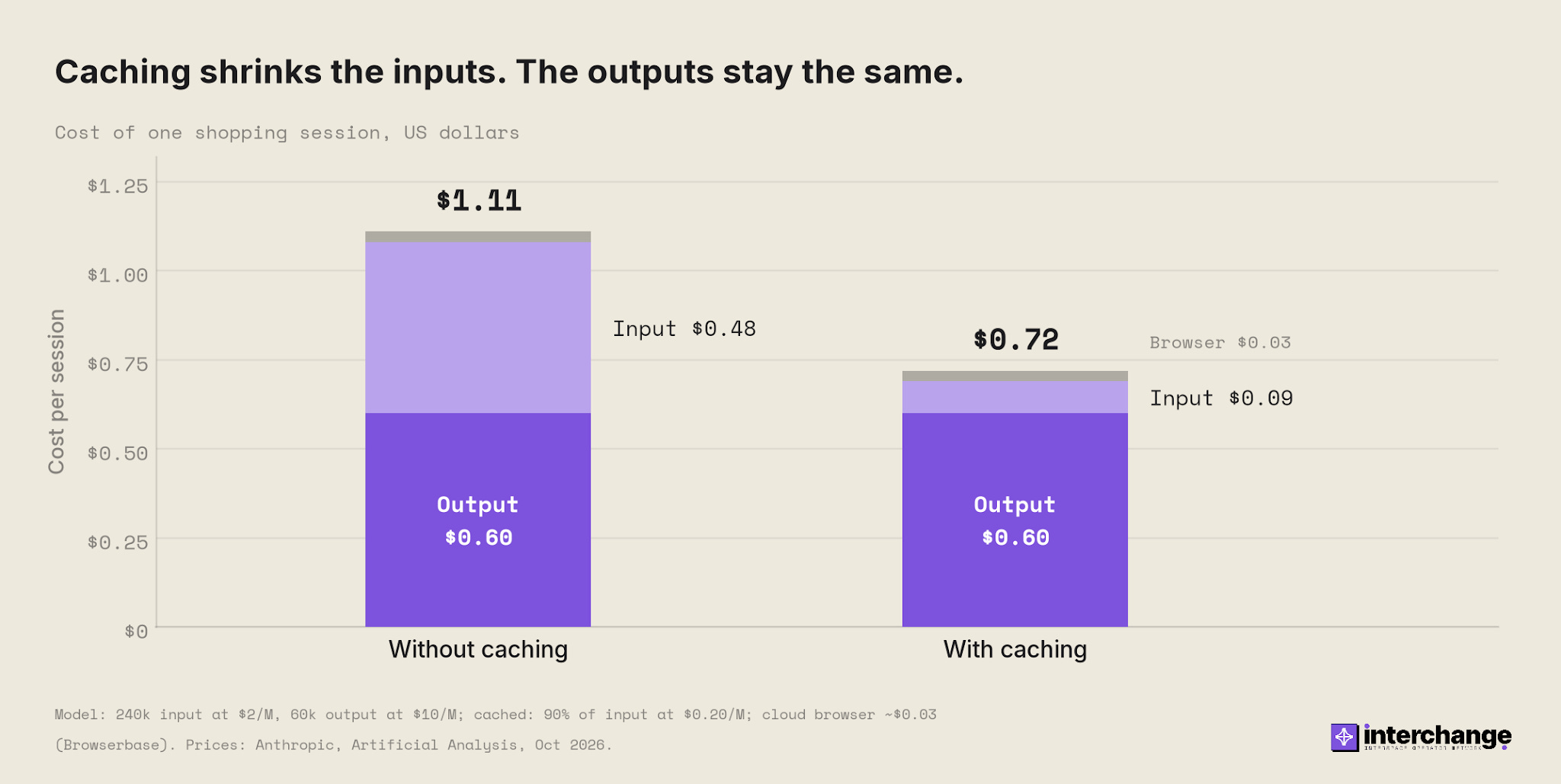
Caching cuts the inputs by more than 80%. The outputs don’t move: that’s the model reasoning about each page and deciding what to click next, and it’s new every time, so $0.60 of the $0.72 is output.
Incremental expenses not factored in
Of course, even here we’re being conservative on costs. I’m only modeling contribution: what one booking earns minus the AI and browser costs to make it. True profitability has to pay for everything:
Support. Changes, cancellations, refunds, and “my seat assignment disappeared.” Each is another agent session, and none of them pay. One support conversation per booking adds another ~$0.72.
Failed bookings. Fares that change mid-checkout, sessions that break, payments that fail.
Mistakes. When an agent cancels the wrong flight, someone eats that cost.
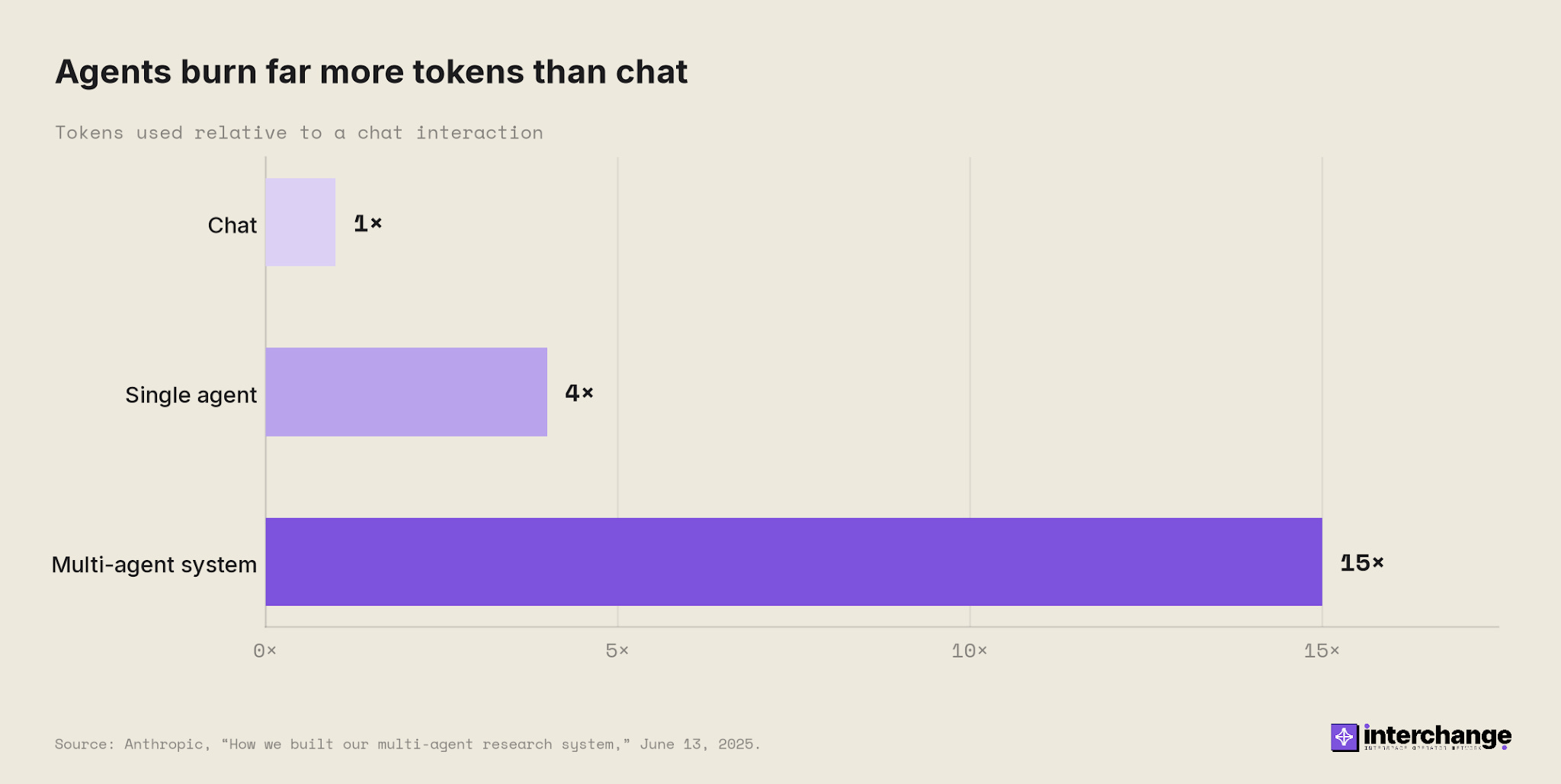
Browser agents. The browser time is in the model, but proxies and captcha solving aren’t. And my 300k is for a single agent. A lead agent handing work to sub-agents would roughly double it, and at 600k tokens one session costs about $1.41 instead of $0.72. For scale, Anthropic found agents use about 4x the tokens of a chat, and multi-agent systems about 15x. In one benchmark, a browser agent used about 45 times the tokens of an API-connected agent on the same task.
Payments and fraud. If the agent is in the flow of funds, it carries some of that risk.
Everything free. Most of what a personal agent does (reminders, reservations, emails) earns nothing at all. Flights are subsidizing those.
Your team, your infrastructure, your overhead.
Set all that aside. On contribution alone, $0.72 against $3.12 of revenue looks great. More than 4x.
This is the number in most pitch decks. It’s the wrong number.
Step three: Incorporate User Behavior
Think about how you buy a flight. You check prices. You come back two days later. You check another site. You ask your partner. You check again.
A Bain and Google study of nearly 9,000 travelers found the average booking took 30 online sessions, 33 searches and 12 travel sites over 19 days. That covers all travel, not just flights. Flights don’t look any lighter: Expedia’s 2023 research has air bookers planning slightly longer than the average traveler, and an earlier Expedia study found 48 flight searches across eight sites before booking.
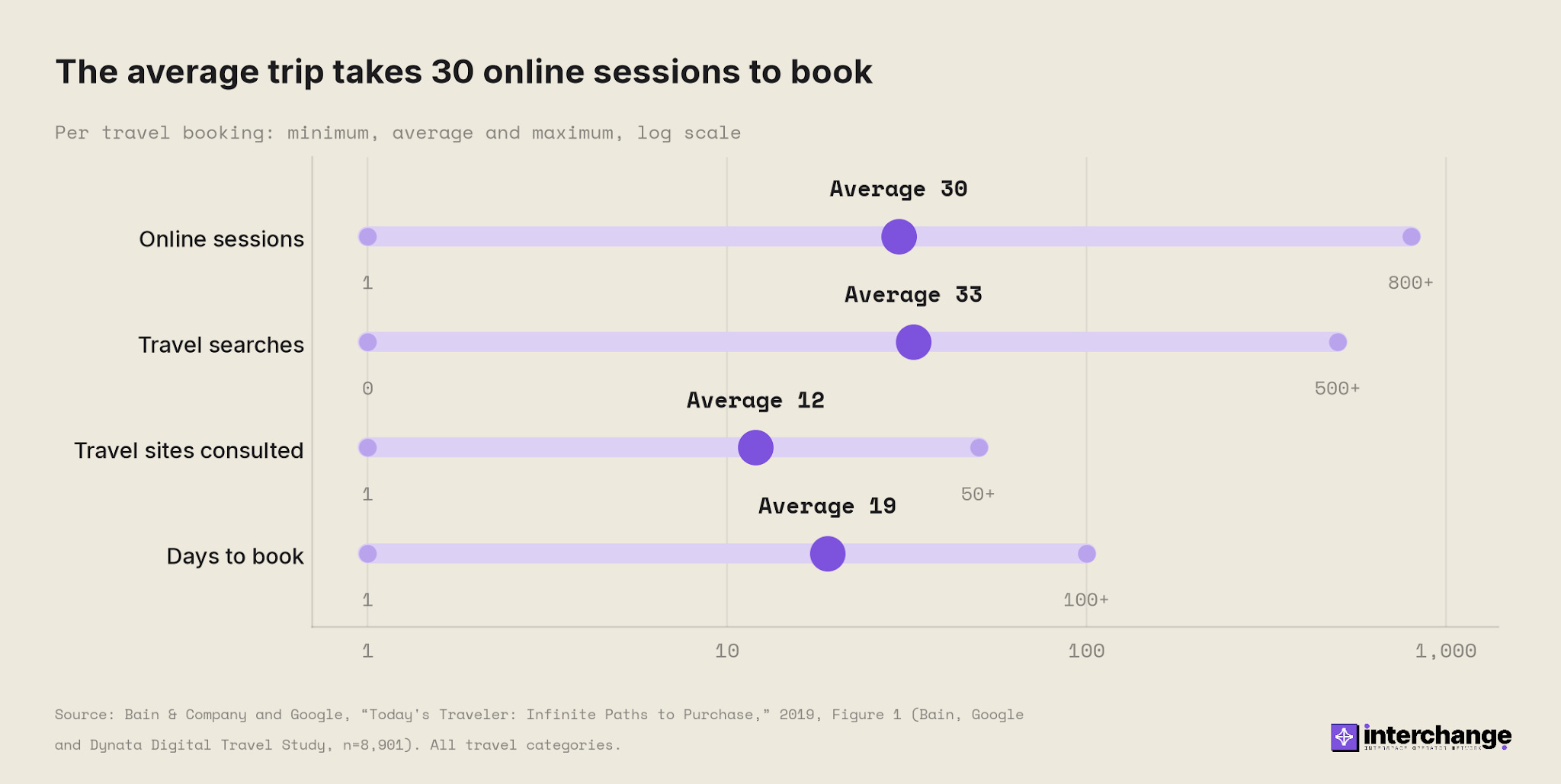
Still, I’ll cut it in half for flights: 15 sessions for the benefit of the doubt. Then I’ll assume an agent is twice as efficient as a person. It runs several searches in one sitting, and plain price tracking doesn’t need an AI model at all. That gets us to ~7, at best.
Sessions per booking = 30 human sessions × 50% for flights ÷ 2x agent efficiency ≈ 7
Cross-check: 48 flight searches at six searches per agent session is eight sessions.
Every session costs money. Only the last one earns money.
Not every session ends in checkout, but the research sessions aren’t light. Some of it could run on cheaper models, but comparing real options still takes a capable agent in a browser. A browser agent reads every results page fresh, and pages change at every step, so far less of it gets cached than in a tidy chat. My 90% caching assumption is already kind.
7 sessions × $0.72 = $5.05 to make one booking.
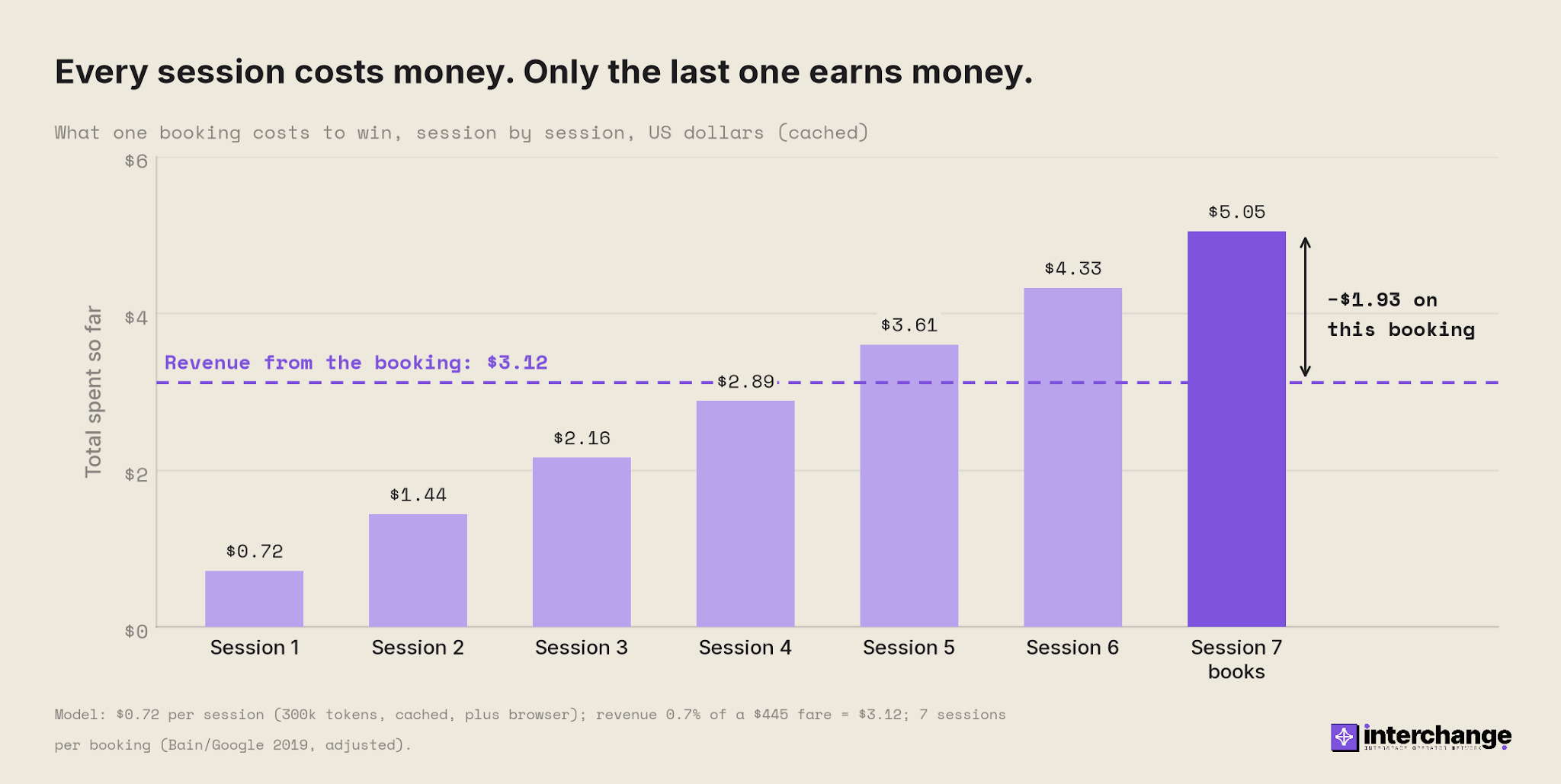
Against $3.12 of revenue, that’s −$1.93 per booking. Without caching, it’s $7.77 and −$4.65.
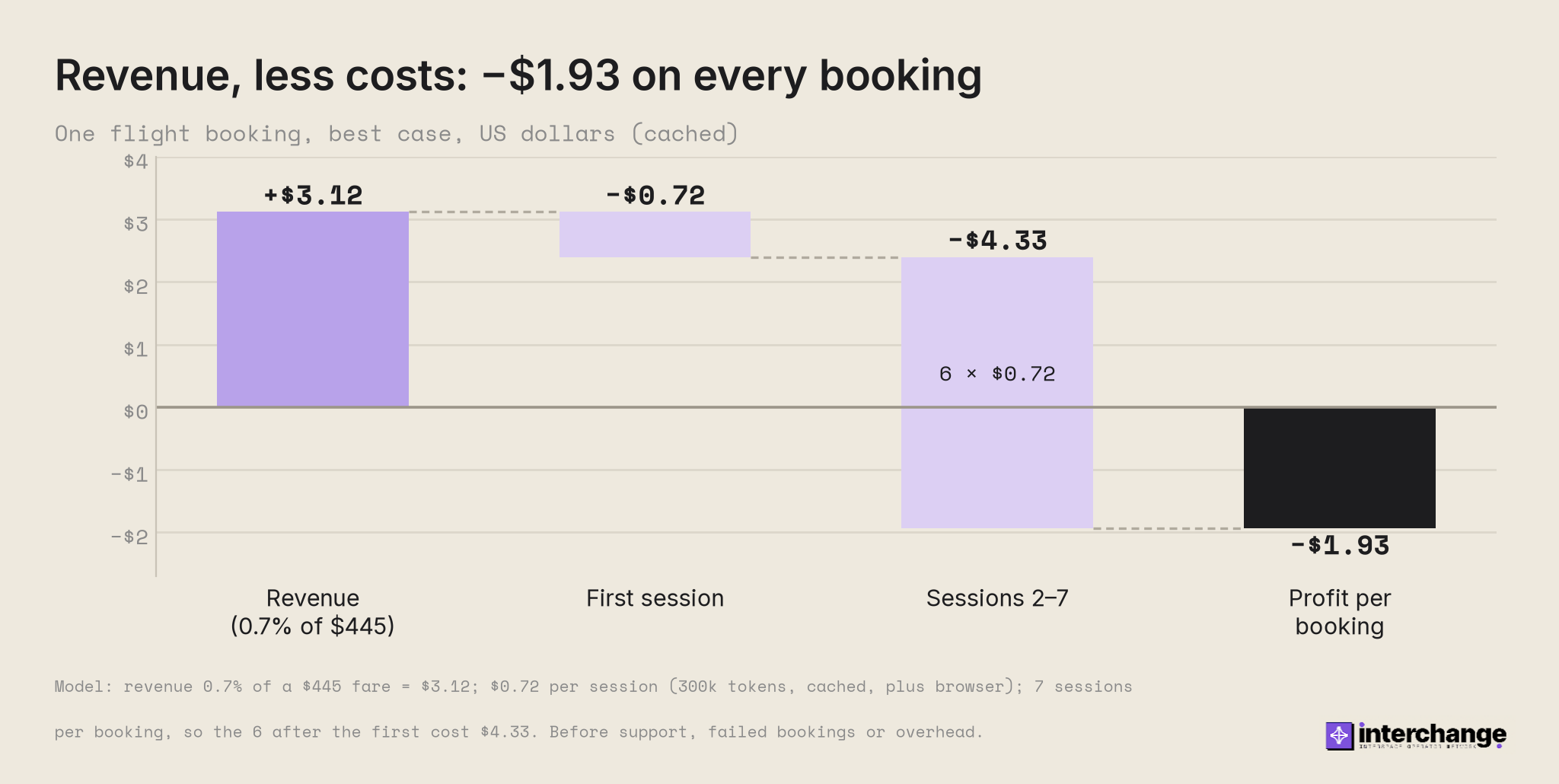
Myth Busted.
But what would it take to break even?
So the math doesn’t work and it’s not particularly close. And that’s the best world, today: a median-priced capable model, near-perfect caching, only seven sessions, the average fare, and the average 0.7% commission in a market where the base commission is zero.
And you still lose money on every booking.
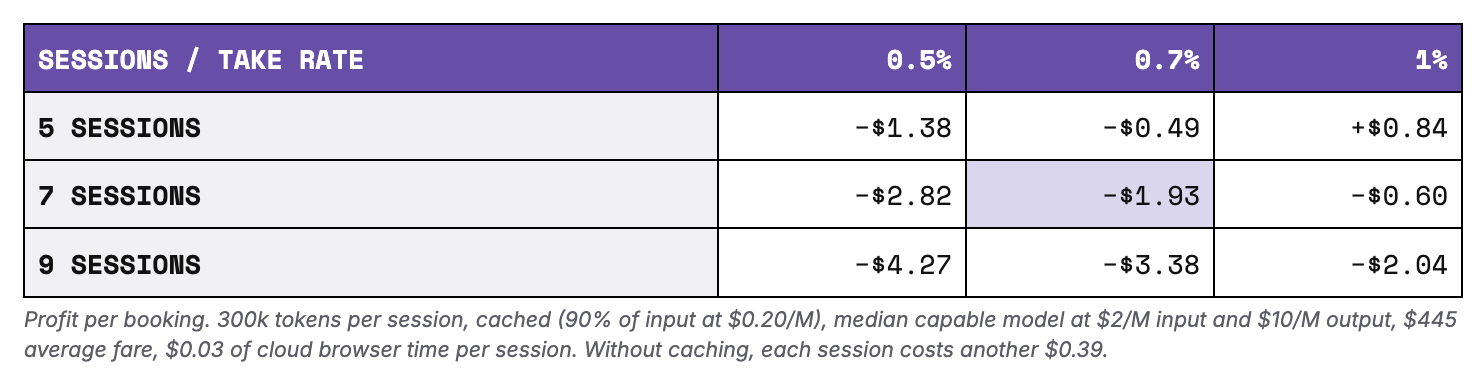
At 0.7%, a booking breaks even at:
4.3 sessions per booking with caching, or 2.8 without
or a take rate of about 1.1% at 7 sessions, right at the top of what any affiliate partner gets paid.
Could agents get people from intent to purchase in fewer sessions? Maybe. But airlines and OTAs have spent 25 years optimizing that funnel.
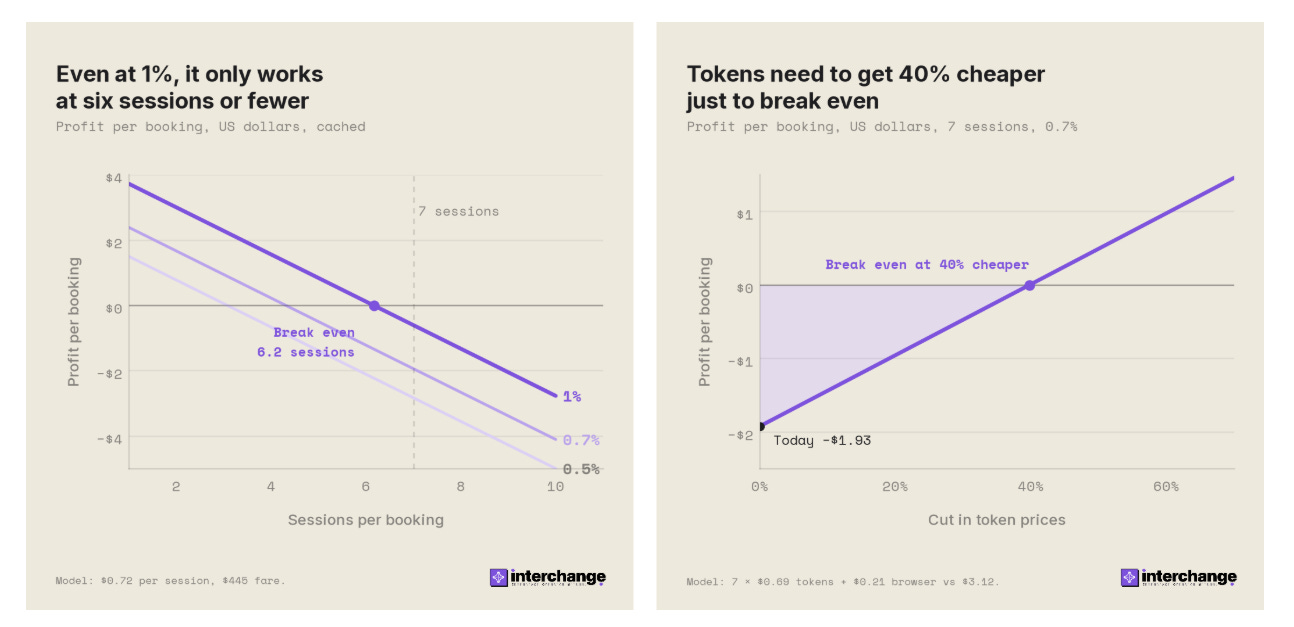
Could a cheap model do it? Some models score well and cost a tenth of the median. If one can reliably handle a real multi-traveler, international checkout end to end, the math changes but I haven’t seen that yet. In fact, the opposite seems to be the case - that when you use dumber, cheaper models, agentic commerce is less effective.


“But tokens keep getting cheaper”
Sometimes. The cost of reaching a fixed level of capability has fallen fast. But the price of the newest, most capable models hasn’t moved in a straight line, and in 2026 effective token spend actually rose for stretches.
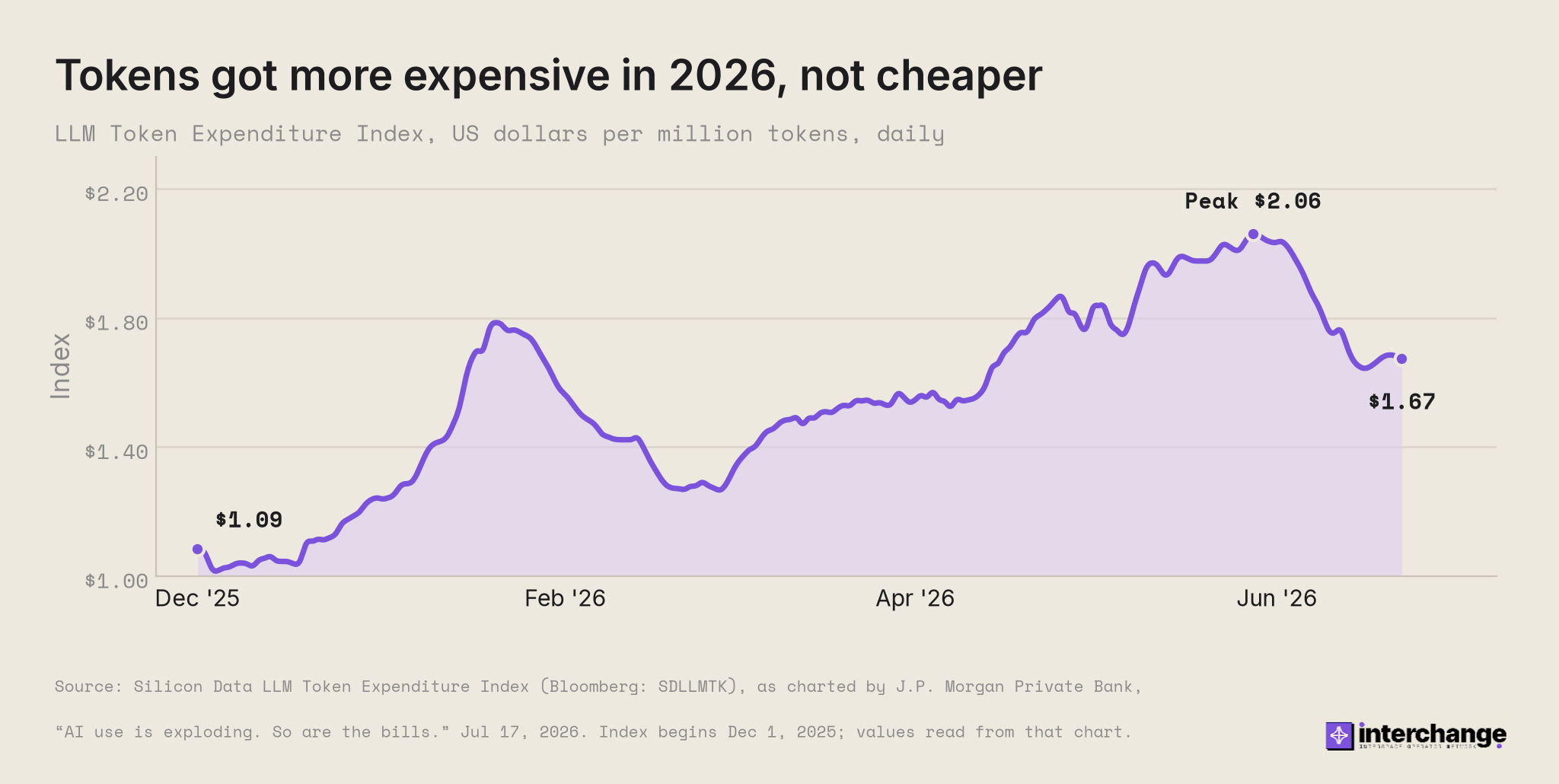
Breaking even would take tokens about 40% cheaper. Even 30% cheaper still loses about $0.47 a booking. And that’s the best case with nothing else in it: no support, no failures, no free work, no overhead. Cheaper tokens fix the toy version of this business, not the real one.
More importantly, cheaper tokens haven’t meant cheaper tasks. Agents use more of them every year: longer contexts, more tools, more reasoning, more autonomy. And the requests are getting harder, not easier. Today it’s “find me a flight.” Tomorrow it’s “find the row where the middle seat is least likely to sell, on a flight with a bassinet seat, under $50 more.”
Every clever thing an agent learns to do is more tokens on the same $3.12.
So where does the money come from?
If a take rate alone can’t pay for the work, the economics have to come from somewhere else. Here’s where I’d look:
Advertising. There’s a big opportunity in intent-based ads inside results. Search for a flight, and airlines could pay for placement that highlights their extras, making them easier for an agent to compare.
A bigger cut earned on value provided. If an agent can prove it drives truly incremental spend, trips and purchases that wouldn’t have happened otherwise, it has a case for an Afterpay-style merchant fee. Afterpay charges merchants about 6% plus 30 cents a transaction but of course it does so with a compelling argument that credit extension makes purchases happen that otherwise wouldn’t. This is a big if for agentic commerce, and it raises real questions about who eats the fraud and chargebacks when an agent books the wrong thing.
Credits. Give every user a monthly budget of agent work, and charge when they go past it. While it creates friction, it drives alignment, which tends to work in a company’s favor against inference abuse. Heavy users pay for heavy use, which is how AI subscriptions already work.
Owning the relationship. If agents become where people start shopping, merchants could pay them some of what they now spend on marketing, which runs 21 to 50% of revenue at the big travel platforms. That’s real money, but it’s a share of a budget, and the agent still has to win the customer first.
My guess at what’s behind the $30B: a card. An agent that pays with its own card earns interchange (the fee the merchant’s bank pays the card issuer) on everything it buys, and suddenly it looks like Ramp for consumers.


It won’t save the model. US banks earn about 1.82% of purchase volume in interchange and hand back 1.57% as rewards. That leaves about a quarter of a point before fraud, credit losses, the partner bank’s cut, and running a card program. On the $445 fare, that’s about $1.11, not enough to save the economics.
The verdict
Myth busted at today’s inference prices, and it holds even if token prices move 30% in either direction.
I’m not saying agents won’t book your flights. They will, and they’ll be great at it.
I’m saying commission-based agentic commerce, the “we’ll take a cut of what you buy” model, doesn’t cover the cost of the work at today’s inference prices. The winners will need more than a take rate.
And flights are the good case. They pay a commission at all, and the buyer shows up knowing what they want. Shopping can pay better rates, but it likely takes even more sessions, and plenty of people have the agent find the product, then buy it themselves in the store’s app. Most of what an assistant does for you pays nothing.
If the math doesn’t work here, where does it?
Sources:
Reuters, “AI agent firm Instinct raises $1 billion in latest funding round,” Sept 28, 2026 (Series C, $10B, Sequoia, Benchmark and Coatue). TechCrunch, “Viral AI startup Instinct has raised $350M at a $2.5B valuation,” Aug 26, 2026 (Series B, co-led by Index Ventures and Benchmark). Startup Fortune, Aug 29, 2026 (Series A of $75M at $500M led by Kleiner Perkins; seed backed by Conviction and Greenoaks at about $50M; about $350M raised in total through the Series B, which implies a seed of roughly $25M). Lukas Gruber on X, Oct 27, 2026, said Instinct is raising at about $30B; unconfirmed by the company. https://www.reuters.com/technology/ai-agent-firm-instinct-raises-1-billion-latest-funding-round-2026-09-28
Noah Shinn on Invest Like the Best, “Instinct: The Personal Agent,” Episode 493, Sept 28, 2026. https://colossus.com/episode/instinct-the-personal-agent
Staylight, “OTA Commission Rates Explained (2026),” July 28, 2026: hotel commissions to OTAs typically run 15% to 25% of the booking value. https://staylight.io/learn/ota-commission-rates-explained
Expedia Group Affiliate Program, Commission terms, Oct 2026: hotels 4% of net transaction value; flights earn no commission in Expedia’s own program. Booking.com pays affiliates 25–40% of its own commission, about 4% of booking value (AffiliatePicker, Aug 2026). CoStar, 2025 US average daily rate $160.54 (Jan 20, 2026). SiteMinder, 2025 average US stay 1.61 nights (via Asian Hospitality, Feb 7, 2026). https://affiliates.expediagroup.com/commission-terms
Delta Air Lines press release, March 14, 2002; timeline of other carriers following within ten days in In re Travel Agent Commission Antitrust Litigation (6th Cir. 2009). https://downloads.regulations.gov/DOT-OST-2002-11577-0018/attachment_1.pdf https://caselaw.findlaw.com/court/us-6th-circuit/1498399.html
Los Angeles Times, “Commission decision puts travel agents on defensive,” March 22, 2002 (5% of fare, up to $20). https://www.latimes.com/socal/daily-pilot/news/tn-dpt-xpm-2002-03-22-export38764-story.html
Travelpayouts, “Aviasales Affiliate Program” (Aviasales averages 2.2% of the ticket price and pays partners 1.1–1.3%) and “Expedia Affiliate Program” (flights 0.30–0.48% of booking value). Aviasales is mostly a Russian business: its CEO put about 80% of it in and around Russia (Ostexperte, May 14, 2018), and the US is about 2% of aviasales.ru traffic (Siterate, Sept 2026). https://www.travelpayouts.com/en/offers/aviasales-affiliate-program https://www.travelpayouts.com/en/offers/expedia-us-affiliate-program
Mark Pestronk, Travel Weekly, “Whether in reaction to NDC or not, GDS offers are better than ever”, Jan 16, 2019: large-agency offers average about $1.97–$2.17 per segment, less an 80-cent full-content fee. Sabre’s 10-K calls this incentive “a commission paid to the travel agency for booking travel on our GDS.” https://www.travelweekly.com/Mark-Pestronk/Whether-reaction-NDC-not-GDS-offers-better-than-ever https://investors.sabre.com/static-files/ee62563d-3593-4fb5-a2c3-58139faa9892
Mark Pestronk, Travel Weekly, “GDS incentives are as robust as ever”, Jan 16, 2026: offers are better than at any point in 42 years; top deals take 200,000+ annual segments. Sabre’s FY2025 10-K shows cost of revenue excluding technology, mostly incentive consideration, of $1,207M on 365M bookings (under $3.31 each), with incentives up $56M on higher rates. https://www.travelweekly.com/Mark-Pestronk/GDS-incentives-are-as-robust-as-ever https://www.sec.gov/Archives/edgar/data/1597033/000162828026008800/sabr-20251231.htm
Bureau of Transportation Statistics, “Second Quarter 2026 Average Air Fare Increased 2.0% from First Quarter 2026,” Sept 29, 2026. Average domestic itinerary fare, $445. https://www.bts.gov/newsroom/second-quarter-2026-average-air-fare-increased-20-first-quarter-2026
Dealroom, “Noah Shinn: Instinct compounding at 10% a day as agents go mainstream,” Sept 29, 2026, summarizing Invest Like the Best Ep. 493: free for users, a take rate paid by merchants. https://dealroom.co/news/talk-Am7IWP8IpEc-noah-shinn-instinct-compounding-at-10-a-day-as-agents-go-mainstream
Fortune, “Noah Shinn, Instinct AI assistant,” Sept 30, 2026. 100,000+ users: Tech Funding News, “AI agent Instinct seeks $1B at $10B valuation in talks with Sequoia, Benchmark,” Sept 18, 2026, citing The Information. https://fortune.com/2026/09/30/noah-shinn-instinct-ai-assistant-meta-muse-alexandr-wang-tech-series-c-ai-agent-mark-zuckerberg/ https://techfundingnews.com/ai-agent-instinct-seeks-1b-at-10b-valuation-in-talks-with-sequoia-benchmark
Expedia Group, Form 10-K for fiscal year 2025. Direct sales and marketing $7,349M on revenue of $14,733M (49.9%). Peers: PhocusWire, “OTAs’ marketing spend exceeded $20B in 2025,” Feb 27, 2026 (Booking Holdings 30%, Trip.com 24%, Airbnb 21% of revenue); Tripadvisor FY2025 results (marketing 41.8% of revenue). https://www.sec.gov/Archives/edgar/data/1324424/000132442426000008/expe-20251231.htm
Duffel, Pricing, Oct 2026: $3.00 per order, 1% of order value for Managed Content (selling under Duffel’s airline accreditation), and $2.00 per paid extra such as a bag or seat. https://duffel.com/pricing
Travel Weekly, “Expedia makes fee-free air bookings permanent,” June 1, 2009 (fees of $7 to $11); “Expedia’s competitors match permanent elimination of air fees,” June 3, 2009. https://www.travelweekly.com/Travel-News/Online-Travel/Expedia-makes-fee-free-air-bookings-permanent https://www.travelweekly.com/Travel-News/Online-Travel/Expedia-s-competitors-match-permanent-elimination-of-air-fees
Anthropic, Computer use tool docs, Oct 2026: the toolset adds about 4,500 input tokens per request; each screenshot adds roughly 1,000–1,800 more. Billed at standard token prices. https://docs.anthropic.com/en/docs/agents-and-tools/tool-use/computer-use-tool
Artificial Analysis, model pages, Oct 2026. The 13 models with Intelligence Index ≥ 45 and a public price, from DeepSeek V4.1 Flash ($0.30/$1.20) to Claude Fable 5.1 and GPT-6 Astra ($10/$50). Median $2/$10. https://artificialanalysis.ai/models
Anthropic, API pricing, Oct 2026 (Sonnet 5.5: $2/M input, $10/M output); Gemini 4 Argon and GPT-6.1 Sol on Artificial Analysis. https://www.anthropic.com/pricing https://artificialanalysis.ai/models/gemini-4-argon https://artificialanalysis.ai/models/gpt-6-1-sol
Cache reads list at 5–10% of the input price, e.g. $0.10–$0.20/M on Claude Sonnet 5.5 and Opus 5.5 (Anthropic pricing). I use $0.20/M to stay cautious. At $0.10/M, the best case improves from −$1.93 to about −$1.78. https://www.anthropic.com/pricing
Browserbase, Pricing, Oct 2026: $0.10–$0.12 per browser hour past included usage. Bain 2026 found browser agents looping 5 to 30 minutes per task; I use 15. https://www.browserbase.com/pricing
Anthropic, “How we built our multi-agent research system”, June 13, 2025. https://www.anthropic.com/engineering/multi-agent-research-system
Reflex, “Computer use is 45x More Expensive Than Structured APIs,” Apr 27, 2026. Same Claude Sonnet model and task: 551k input tokens via screenshots vs. 12k via API. https://reflex.dev/blog/computer-use-is-45x-more-expensive-than-structured-apis
Noah Shinn on Invest Like the Best, “Instinct: The Personal Agent,” Sept 28, 2026, from 54:46. https://colossus.com/episode/instinct-the-personal-agent
Bain & Company and Google, “Today’s Traveler: Infinite Paths to Purchase”, 2019, Figure 1 (Bain, Google and Dynata Digital Travel Study, n=8,901). Covers all travel bookings. https://www.bain.com/globalassets/noindex/2019/bain_brief_todays_traveler_infinite_paths_to_purchase.pdf
Expedia Group, “The Path to Purchase: Air bookers”, 2023 (41 days of research and planning vs. the all-traveler average); Expedia, “Upgrade Options”, Dec 11, 2015 (48 searches on eight sites before booking a flight). https://partner.expediagroup.com/content/dam/unified/partner/documents/reports/2023-reports/path-to-purchase/en-us/2023-path-to-purchase-Air_en-us.pdf https://www.expedia.com/stories/upgrade-options/
Formula: profit per booking = (fare × take rate) − sessions per booking × (tokens per session × blended price per token + browser cost per session). Sensitivity: at 250k tokens per session, the best case (0.7%, 7 sessions, cached) still loses $1.13 per booking, before support, failures or overhead. A frontier model at $4/$20 roughly doubles every cost figure.
J.P. Morgan Private Bank, “AI use is exploding. So are the bills.”, July 17, 2026, citing the Silicon Data LLM Token Expenditure Index (Bloomberg: SDLLMTK). https://privatebank.jpmorgan.com/nam/en/insights/markets-and-investing/tmt/ai-use-is-exploding-so-are-the-bills
Payment Review, “What buy now, pay later costs merchants in 2026,” Sept 12, 2026: Cash App Afterpay at 6% plus 30 cents per transaction on Stripe and Square, against 2.9% plus 30 cents for a card. https://paymentreview.com/blog/bnpl-merchant-fees-2026
Drechsler, Jung, Peng, Supera and Zhou, “Credit Card Banking,” Federal Reserve Bank of New York Staff Report 1143, revised Aug 2026: bank interchange income averages 1.82% of purchase volume and rewards cost 1.57%. https://www.newyorkfed.org/research/staff_reports/sr1143