


Three weeks ago here at Interchange, we were trying to understand how otherwise smart VCs could talk about a $30B valuation for Instinct, a personal agent with almost no revenue. Our view was that the only way we could even begin to see that kind of excitement in today’s applied AI market was if investors saw it as the consumer version of Ramp: an agent that issues its own card, and with scale could get as big as Ramp has. We still think Instinct is building a card.
But Hark got there first. On Monday, Brett Adcock announced the Hark Card: 5% cash back on every purchase made through Hark, with no annual fee and no credit check, plus features like a unique virtual card number for every merchant, so a breach at one store can’t be used anywhere else.
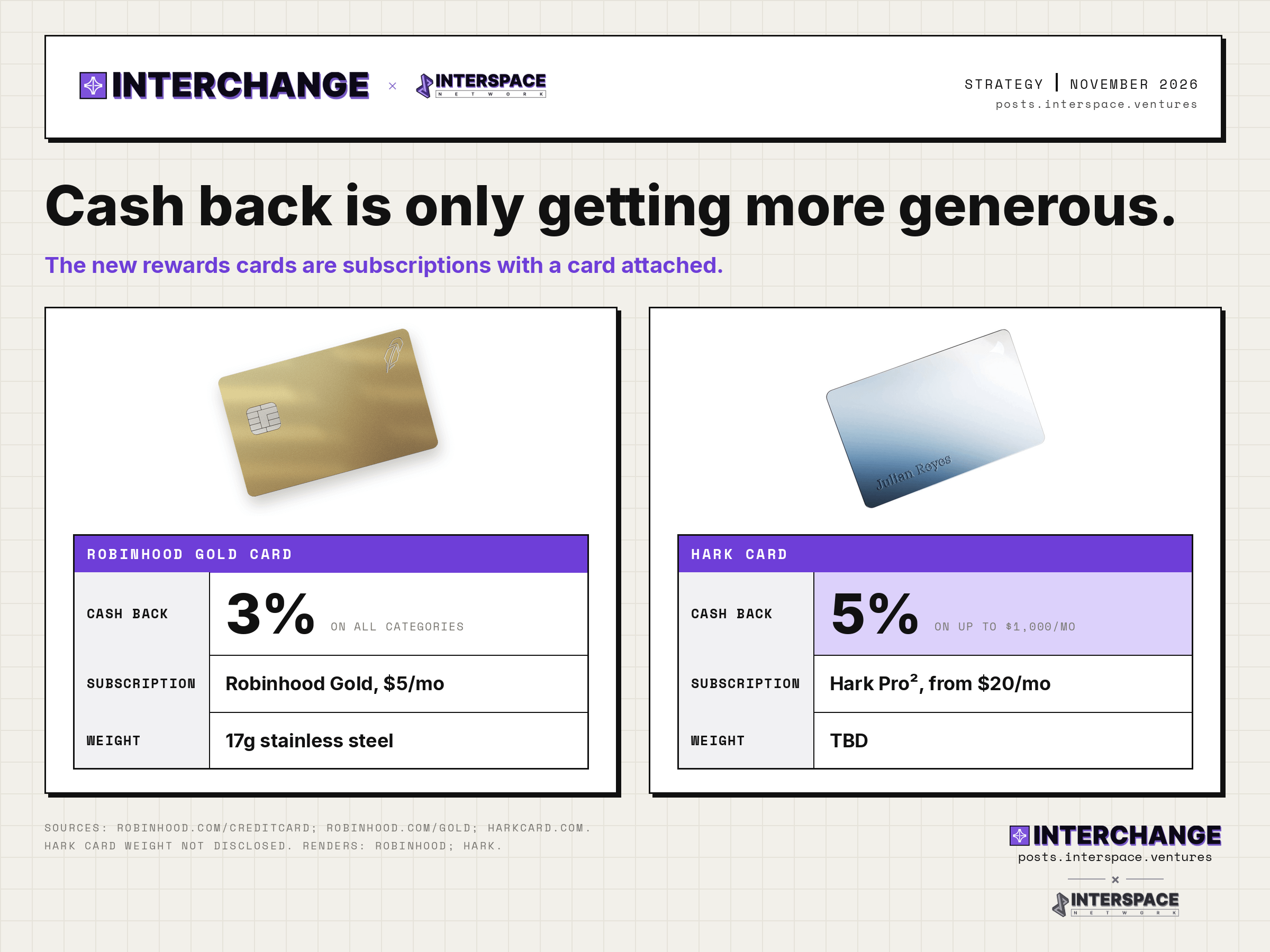
Our initial take, shared on X, is that it’s a smart move. We’ve watched the big banks block agent payments, JPMorgan first among them, “in the name of their users” (aka banker talk for wanting a piece of the pie). As a way to embed into the mindshare and walletshare of the consumer, the card is genius. As a way to make the business model of agentic commerce work, it’s still too early to tell.
We already know two things. (1) In Mythbusters: The Unit Economics of Agentic Commerce, we showed that the cost of inference makes it close to impossible for an agent to pay its way on flight commissions alone. And (2) in The Business of Free, we showed that for a card to pay back significant cash back, it has to rely on levers well beyond pure interchange. Hark has made this even harder for itself, with a higher headline rate and, as you’ll see, a more complex fintech infrastructure. But it may also have more levers than interchange to drive the business forward.
So let’s do an over-engineered fintech deep dive.
1. The over-engineered deep dive, part one: infrastructure
Let’s start with the product construct and the fintech infrastructure providers behind it.
The Robinhood Gold Card is a Visa credit card issued by Coastal Community Bank. It earns credit interchange plus a revolving balance. The card itself has no annual fee, but your $50 a year Robinhood Gold subscription pays for access to it. There’s also a $695 Platinum version with premium travel benefits.
The 5% Hark Card, in contrast, is a prepaid debit card. It’s issued by Lead Bank through Stripe Issuing, also on Visa (kudos to Visa for nabbing both of these new card issuers). The funds sit at Fifth Third. Per the Cardholder Terms, it’s not a credit card and not a checking account, with no overdraft and no credit line.
As you’d expect, the Rewards Terms make clear who funds the 5%: the program is “offered and paid for by Hark Labs,” and rewards are not paid by the issuer or Stripe.
Hark pays in dollars, but your rewards build up in a separate rewards balance that you redeem in the app into your Hark Wallet. They don’t apply to purchases on their own, and anything left in the rewards balance is forfeited if you close your account. So there is some breakage, similar to Robinhood’s points, though likely a little less.
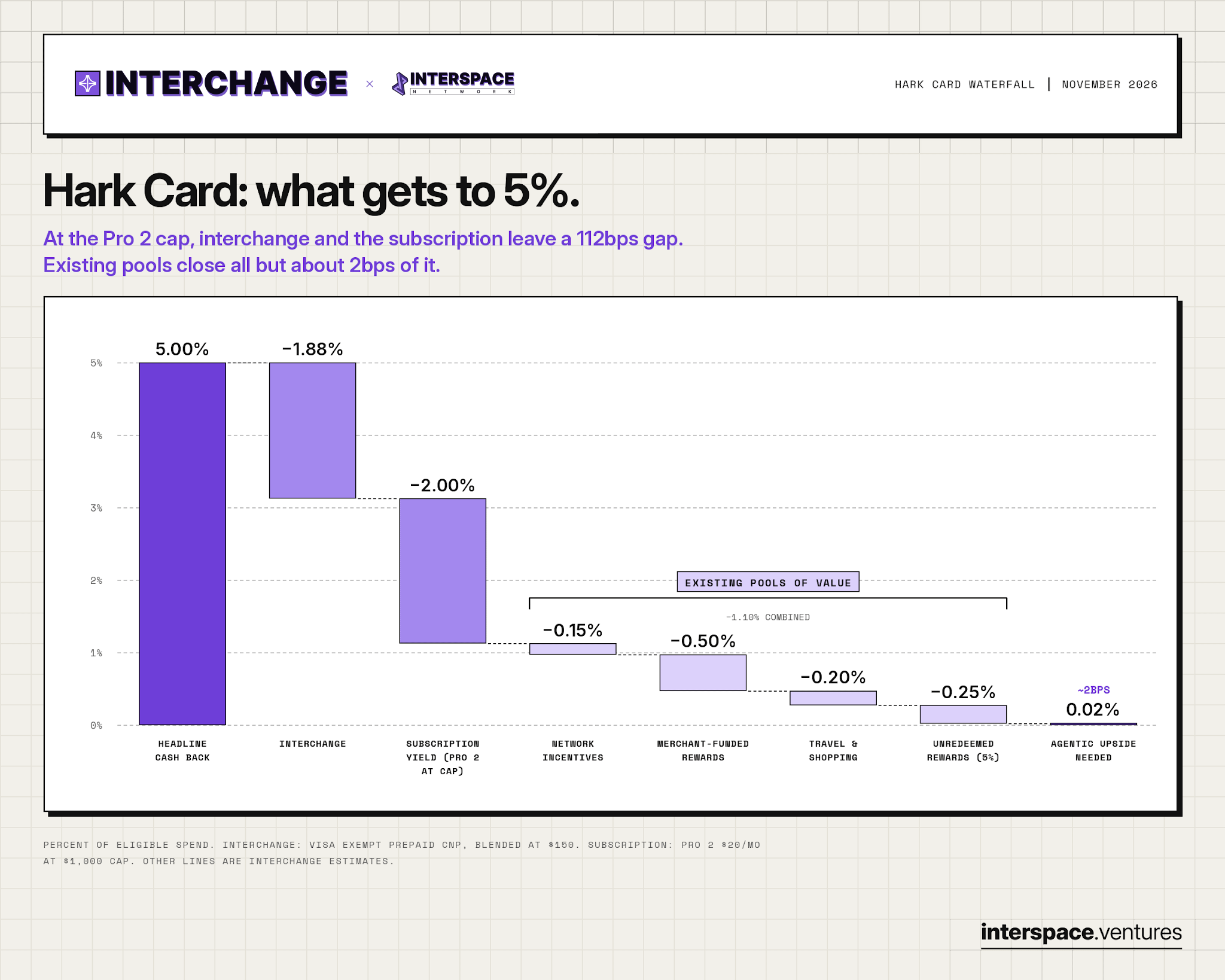
Using prepaid is a clever choice. There’s no underwriting, no credit losses and no revolving balance to fund. Lead Bank is small ($3.08B in assets at Q3 2026), so it’s exempt from the Durbin Amendment, like most fintech issuers. The more important detail is that it’s a prepaid debit card, like the Cash App Card, while Chime issues a regular debit card. Prepaid earns a little more interchange. On Visa's current schedule, an exempt prepaid card-not-present purchase pays 1.75% + $0.20, against 1.65% + $0.15 for exempt debit. Credit card-not-present runs 1.89% to 2.60% + $0.10 depending on the tier. So prepaid edges out debit and sits not that far below credit. Card-not-present is how agentic commerce will mostly happen, so that’s the rate we use. On a $150 purchase, about the average US online order, the $0.20 adds another 13bps, for a blended rate of about 1.88%. A Chime-style debit card would blend to about 1.75% on the same purchase.
2. The over-engineered deep dive, part two: unit economics
Start with what we know. Side by side, as a percent of spend:
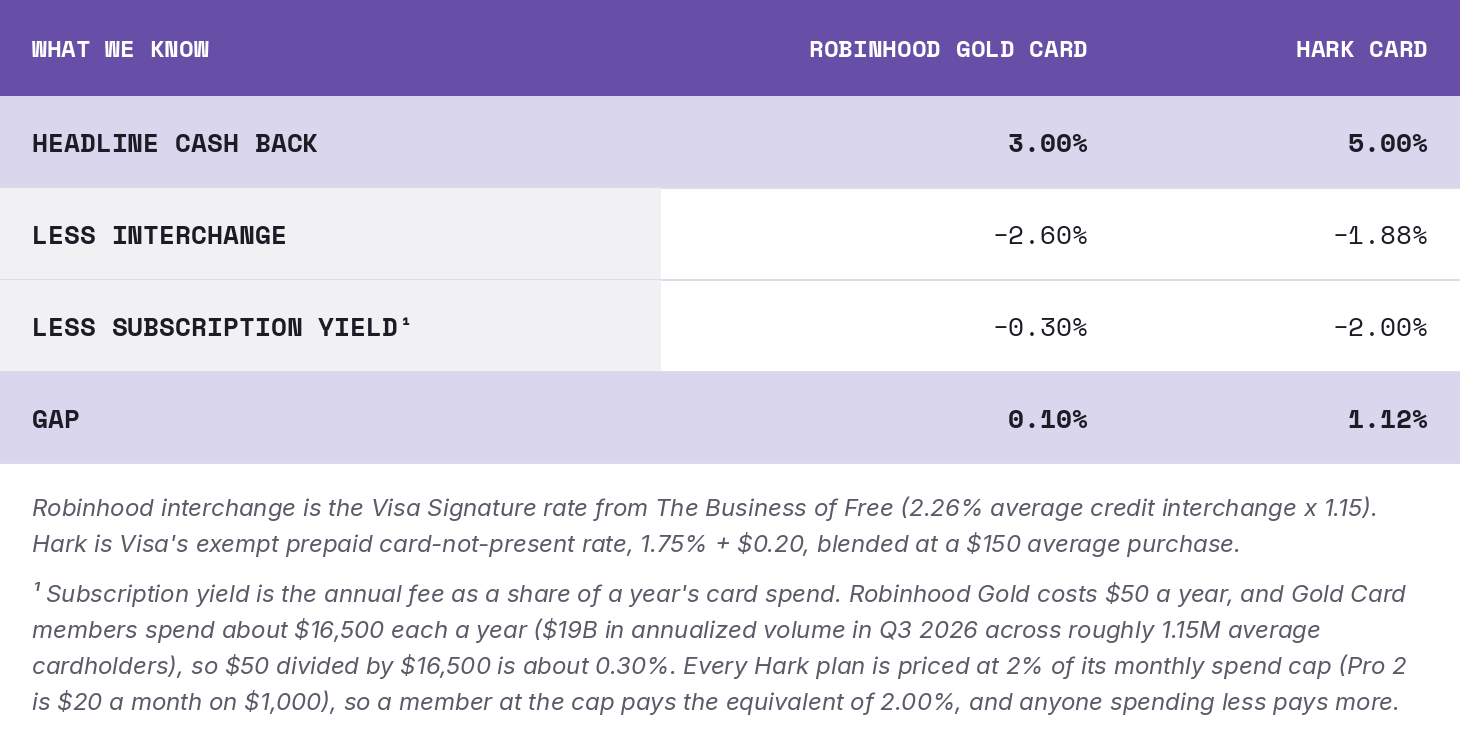
The two cards differ on both sides. Hark starts with less top line (1.88% against 2.60%) and has to give back more (5% against 3%). Before subscriptions, Robinhood’s gap is 40bps and Hark’s is 312bps, almost eight times wider. The $50 Gold fee closes most of Robinhood’s, leaving about 10bps.
The subscription is where Hark looks better. Every plan costs exactly 2% of its spend cap, so a member who spends right up to the cap pays the equivalent of 200bps, and anyone spending less pays more. That still leaves a 112bps gap at the cap. But that subscription also has to pay for the agent itself, which in Mythbusters cost about $5 in inference to book a single flight. So we leave it out of the math below and come back to it at the end.
Robinhood offset its gap with network incentives, merchant-funded rewards, unspent points, travel portal margins and brokerage usage, and ended up about 85bps ahead (the full breakdown is in The Business of Free):
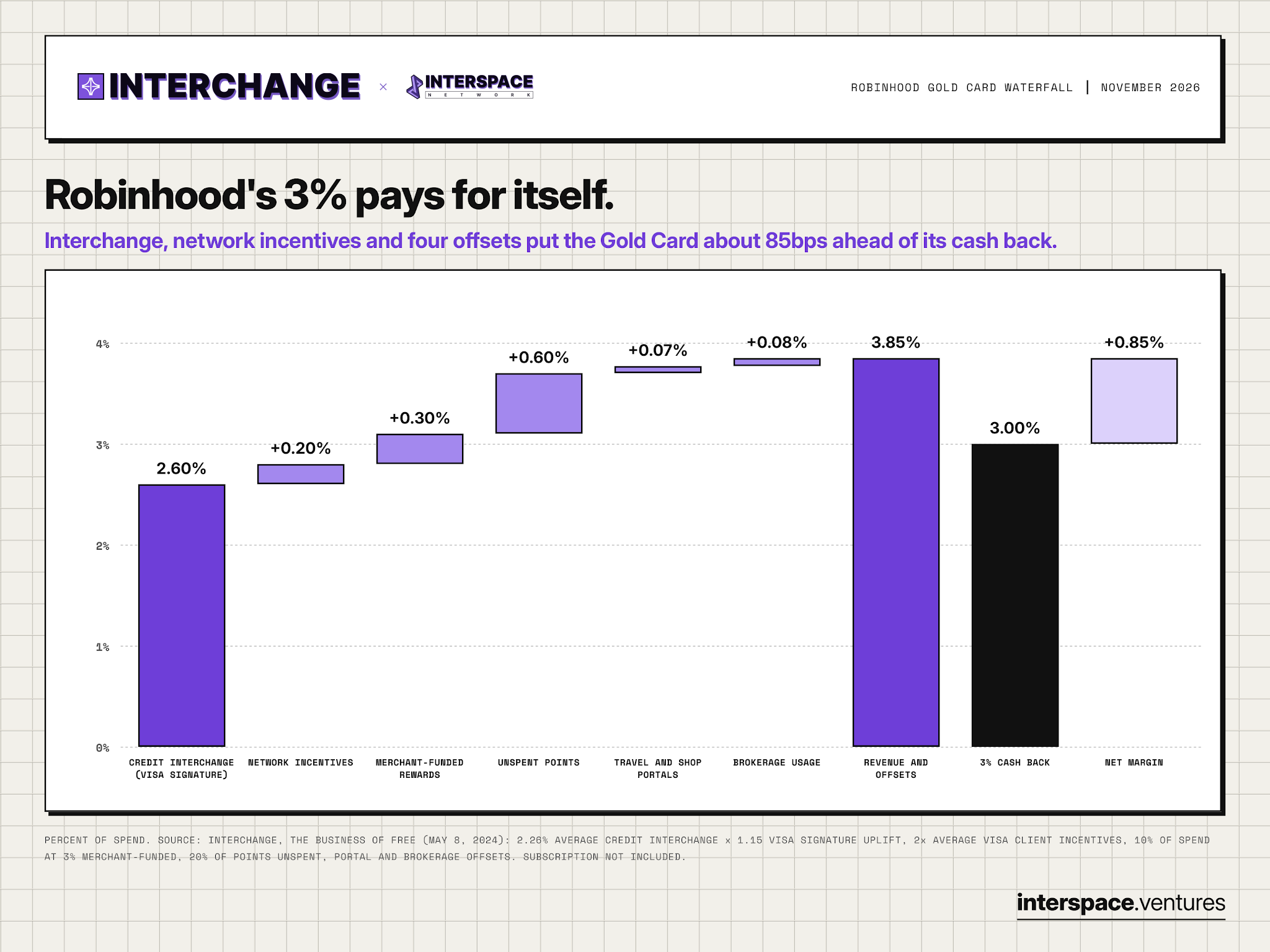
Robinhood Gold Card waterfall, from The Business of Free.
Some of those elements carry over to Hark, and some don’t. Hark doesn’t have a brokerage to send cash back into, and paying in dollars likely means a little less breakage. But an agent opens up levers a card program never had. So what do we need to believe to get to 5%?
Existing pools of value
Network incentives. Visa paid $18.3B in client incentives in fiscal 2026, 28.5% of its gross revenue and up 16% on the year. In The Business of Free we assumed 20bps for Robinhood as a strategic credit issuer. Debit and prepaid programs usually earn less than credit, so we assume a little lower for Hark at 15bps.
There’s a case for more, because the networks are eager to drive volume through agentic commerce. Both are spending to own it, through Visa Intelligent Commerce and Mastercard Agent Pay, and an agent that issues its own Visa credentials, one per merchant, is exactly the volume those budgets exist to win.
Merchant-funded rewards. This works the same way it does for Robinhood. Merchants fund part of the cash back to win incremental sales, usually through offers at select merchants. In The Business of Free we assumed 10% of spend at merchants funding 3%. Hark’s Rewards Terms already let it set higher rates for specific merchants or categories, so we assume 10% of spend at merchants funding the full 5%, or 50bps.
The catch is that merchants often pay these offers on purchases that would have happened anyway. As Phillip Chao of Percents points out, that’s why card-linked offers have stayed at 5 to 10% of affiliate spend for over a decade. An agent helps here, because when it decides where to buy, the spend it sends a merchant is much more likely to be incremental.
Travel and shopping commissions. Robinhood’s travel portal was worth 7bps. Hark books the travel itself, and in Mythbusters a flight booking earned about a 0.7% take rate. Hotels pay more. Spread across all spend, we assume 20bps.
Unredeemed rewards. Robinhood’s math leaned on 20% of points going unspent, worth 60bps of spend. Hark’s dollars are easier to use than points, so we’re conservative here and assume only 5% of rewards go unredeemed, or 25bps.
Agentic commerce upside
A premium for agentic sales. This is a fee for the sale itself, separate from rewards. Afterpay charges merchants about 6% plus 30 cents, roughly double a card, because it can show it creates purchases that wouldn’t otherwise happen. Méliuz, the Brazilian cashback portal, earns 7.6% of GMV in commissions and passes about 70% back to shoppers. An agent that researches, decides and pays has a strong claim to the same kind of premium: a merchant paying more than normal for a customer it couldn’t otherwise reach, at the moment of decision.
Embedded advertising. Amazon’s ads were 9.7% of its net sales in Q3 2026, and Instacart’s were 3.1% of transaction value. ChatGPT Ads passed a $1B run rate in under 200 days. The open problem is proof: seven in ten retail media owners say they can’t show an ad’s value when an agent completes the purchase. An agent with its own card can, because the sponsored result, the decision and the settled payment sit in one ledger.
Adding it up
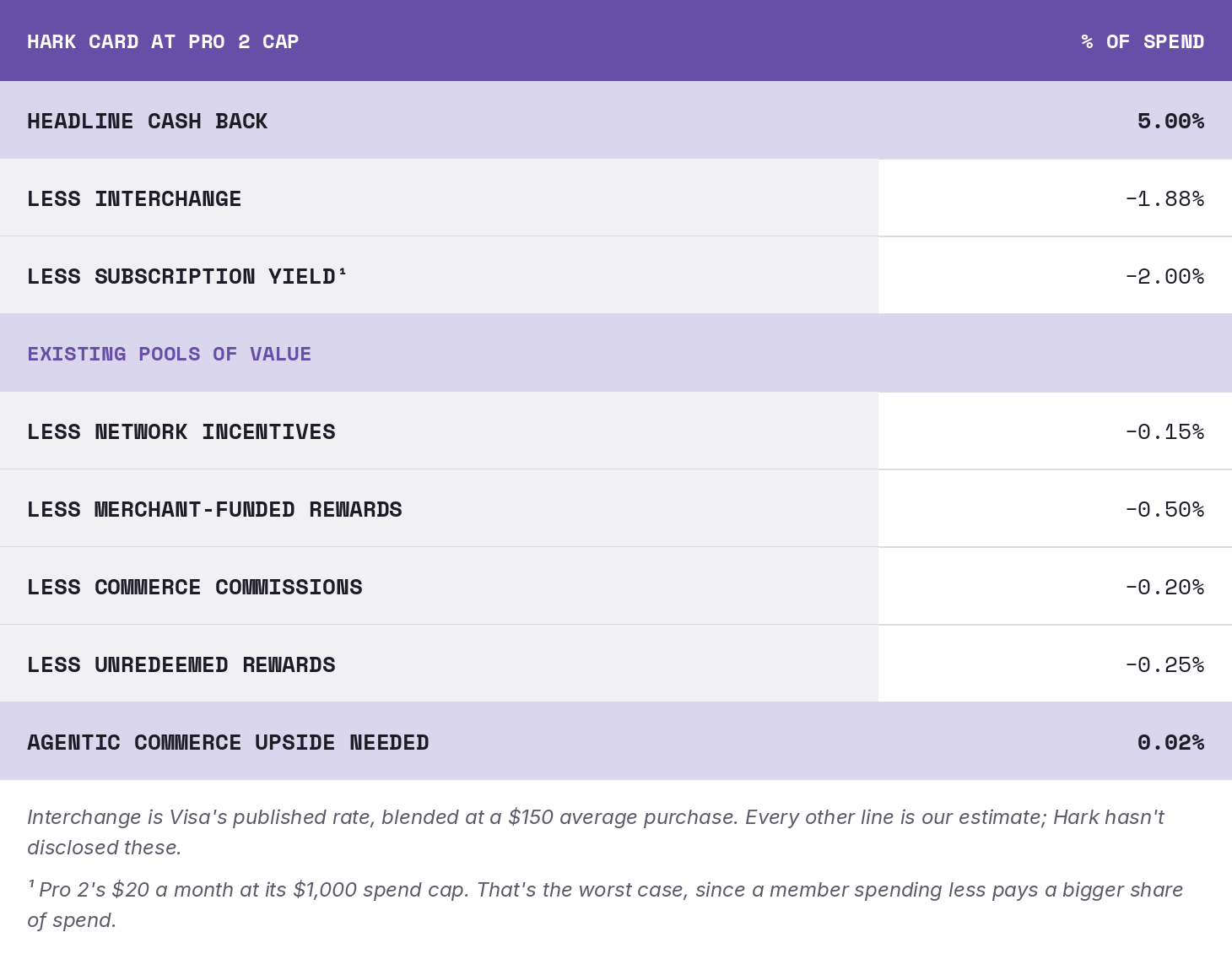
You only need agentic commerce to fill in 2bps to break even. The existing pools close all but about 2bps of it, even with breakage set low. So the 5% roughly pays for itself. What it doesn’t pay for is the agent: inference, support and fraud all come out of the same subscription. That’s the job for agentic commerce. Ads at 50bps of spend (well below Instacart’s 3.1%), plus merchants paying an extra 5 points on about a fifth of spend, would add about 150bps of margin to run the agent on. That second number is the real bet, and it’s the one we’d watch most closely.
There’s more we haven’t modeled. Stripe Issuing’s economics could move the base rate in either direction, since the share of interchange it passes through isn’t public. The float on Wallet balances, which earn cardholders no interest, could be worth something. And some spend will happen in person through a digital wallet, at lower card-present rates.
A note on the subscription
The 5% is a promotional rate through December 31, 2026, up to a monthly spend cap set by your plan. On interchange alone, here’s the monthly spend where each plan’s subscription covers the gap between interchange and 5% back:
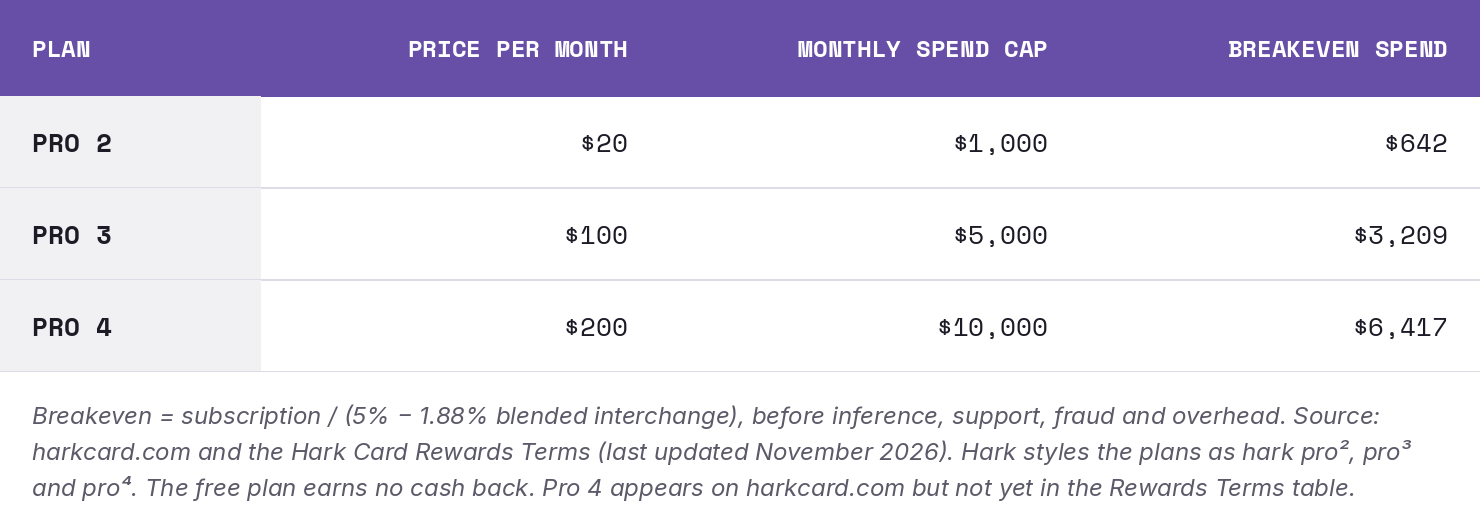
Every plan breaks even at about 64% of its cap. Above that, a member costs Hark money on interchange alone, before a dollar goes to the agent. That’s why the agentic upside matters: it’s what keeps the subscription free to pay for the agent.
3. Why it’s the right bet
We know the team, and we’re excited about what they’re building. The card is the most direct way to turn an agent into a commerce platform. It gets the agent past the banks, gives it spend controls by merchant, and hands it the data merchants and advertisers have wanted for years. On the back of an already fast-growing consumer agent, that’s a real first-mover advantage.
There’s also a real first-mover disadvantage. If it works, every agent startup copies it and competition drives the economics down. Muse and Instinct are surely taking notes, and consumers win either way.
The lesson from The Business of Free still holds. Free was never really free. It worked because someone else in the ecosystem paid. Five can work the same way, as long as the agent is what gets them to pay.